Payload / Mission
GCOM-W1
The GCOM-W (Global Change Observation Mission - Water) or Shizuku satellite aims to construct, use, and verify systems that enable continuous global-scale observations (for 10 to 15 years) of effective geophysical parameters for elucidating global climate change and water circulation mechanisms. Water circulation changes will be observed by a microwave radiometer onboard the GCOM-W (Water) satellite (scheduled to be launched in Japan Fiscal Year 2011). The GCOM-W will observe precipitation, vapor amounts, wind velocity above the ocean, sea water temperatures, water levels on land areas and snow depths. Climate change observation will be performed by a multi-wavelength optical radiometer onboard the GCOM-C (Climate) satellite (under consideration) on clouds, aerosol, seawater color (marine organisms), vegetation, snow and ice. These satellites will enable us to perform comprehensive observations of the surface layer of the Earth such as the atmosphere, including clouds, land, oceans and the cryosphere. The Advanced Microwave Scanning Radiometer 2 (AMSR2) is a sensor to observe radiometers, or microwaves emitted naturally from the ground, sea surface and atmosphere, using 6 different frequency bands ranging from 7 GHz to 89 GHz. The strength of a natural microwave is determined by its characteristics and moisture, including the surface condition and temperature of the material. Although it depends on the frequency, the microwave is very weak. AMSR2 will detect such weak microwaves at an altitude of 700 kilometers and measure the strength of them with a very high accuracy. For example, by measuring the strength of a microwave emitted from the sea surface with the AMSR2, one can understand the water temperature of the sea surface to an accuracy of 0.5 degrees Celsius.
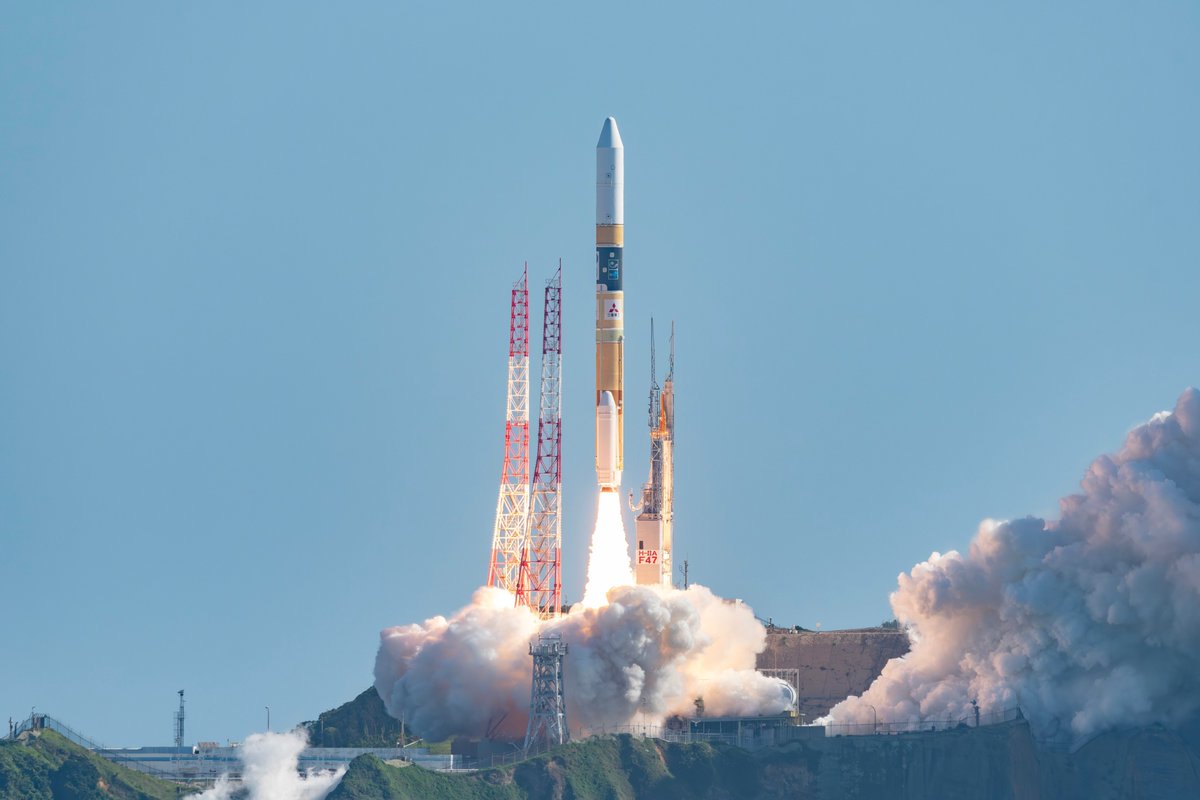
🚀 About the rocket: —






📰 News
Das Nancy-Grace-Roman-Weltraumteleskop befindet sich nun auf einer dreimonatigen Reise über eineinhalb Millionen Kilometer zu seiner endgültigen Umlaufbahn und wird bald die dunkelsten Geheimnisse des Universums enthüllen. Die Mission startete am Sonntag um 13:26 Uhr MESZ an Bord einer SpaceX-Falcon-Heavy-Rakete vom Startkomplex 39A im Kennedy Space Center der NASA in Florida.Eine Pressemitteilung
Das Nancy Grace Roman Space Teleskop der NASA ist bereit zum Start. Der Launch Rediness wurde mit „Go for Launch“ abgeschlossen. Inzwischen steht die Falcon Heavy von SpaceX mit dem Teleskop auf der Startrampe am Startplatz 39A. Der Start ist für morgen (30.08.2026) um 13:25 Uhr MESZ geplant. Der Beitrag 29. 8. 2026 – Nancy Grace Roman Space Teleskop bereit zum Start erschien zuerst auf Raumfahrer
Die Leckstellen im Dockingcompartment des ISS Moduls Swesda konnten abgedichtet werden. Nach Angabe der NASA Managerin Dana Weigel können keine Luftlecks mehr festgetellt werden. Der Beitrag 4. 8. 2026 – Die ISS ist wieder dicht erschien zuerst auf Raumfahrer.net .
Am 27. Juli wurde im KSC eine Speicherkarte mit 1.350.144 Namen an einer Gedenktafel am Nancy-Grace-Roman-Weltraumteleskop angebracht. Die Speicherkarte wird mit dem Teleskop zum Lagrange-Punkt 2 (L2) des Sonne und Erde Systems fliegen. Der Start ist derzeit für Sonntag, den 30. August, um 13:26 Uhr MESZ mit einer SpaceX Falcon Heavy vom Startkomplex 39A des […] Der Beitrag 31. 7. 2026 – 1,35 Mill