📊 Analysis
Statistics & insights on rockets and organizations — technology, history, numbers.
Proton-K/D-2
RetiredKhrunichev State Research and Production Space Center
The Proton-K was a Russian, previously Soviet, carrier rocket derived from the earlier Proton. It was built by Khrunichev, and launched from sites 81 and 200 at the Baikonur Cosmodrome in Kazakhstan.
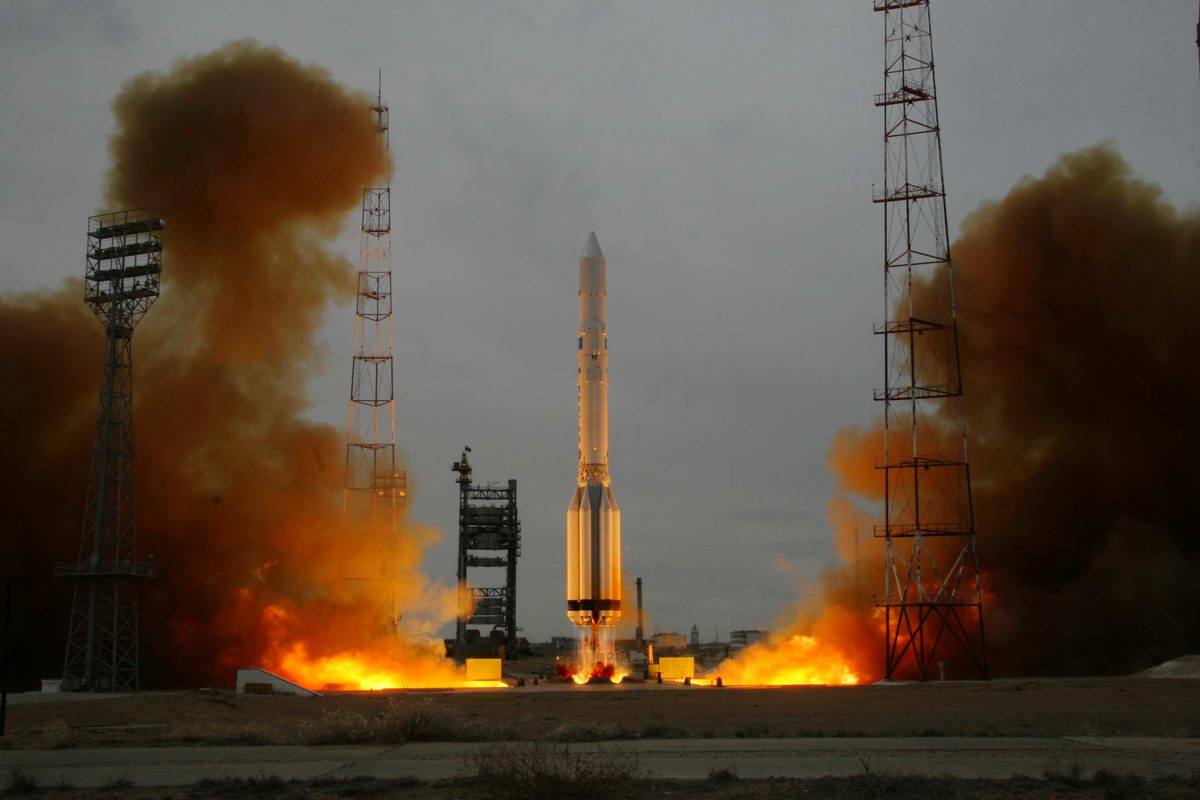
Key figures
Total launches
3
Successes
3
Failures
0
Success rate
100.0 %
Success streak
3
Maiden flight
Jul 7, 1988
Reusable
No
Shortest launch interval ⓘ
4d 23h
Planned launches
0
Proton / UR-500 family total
430 launches · 384 successes · 46 failures (15 variants)
🧐 Data check
Automatic plausibility checks — anomalies are surfaced transparently here:
- ℹ️The figures above apply only to the “Proton-K/D-2” variant. The Launch Library counts each variant separately — the Proton / UR-500 family totals 430 launches across 15 variants.
Technology
Length
57 m
Diameter
4.15 m
Launch mass
710 t
Liftoff thrust
8,847 kN
Stages
4
LEO (low Earth orbit)
6,220 kg
Engines & propellant
| 1st stage | 6× RD-275M | UDMH / Stickstofftetroxid |
| 2nd stage | 3× RD-0210 + 1× RD-0211 | UDMH / Stickstofftetroxid |
| 3rd stage | RD-0213/0214, Briz-M (optional) | UDMH / Stickstofftetroxid |
Engine and propellant data from curated sources: Wikipedia — Proton
Launches per year
of which in our database: 3
Successes Failures Other/planned
History & events
Sources
- Launch Library 2 (The Space Devs)
- Wikipedia