Nutzlast / Mission
Echo
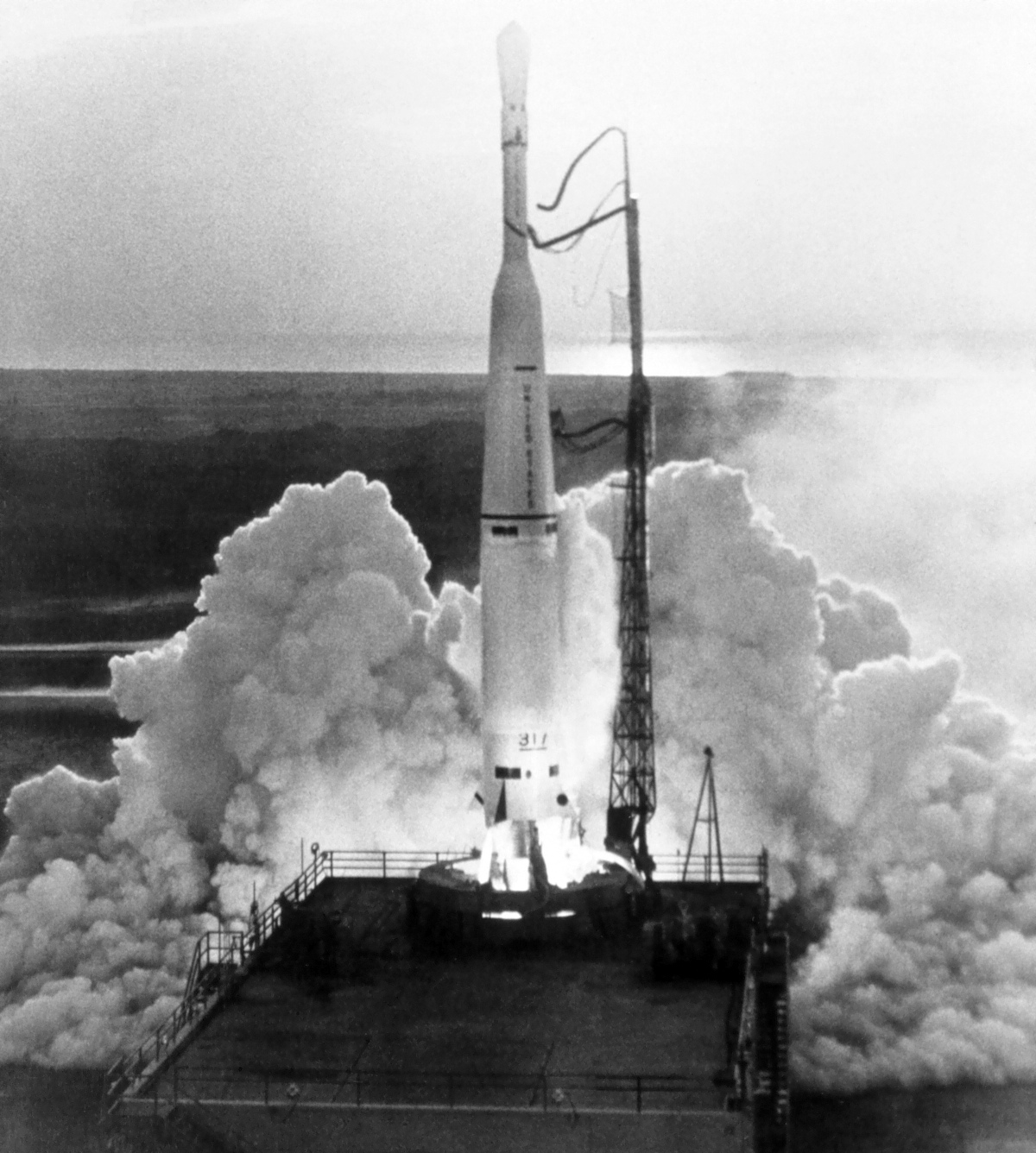
The Echo 1 spacecraft was a 30.48 m diameter balloon of mylar polyester film 0.0127 mm thick. The spacecraft was designed as a passive communications reflector for transcontinental and intercontinental telephone (voice), radio, and television signals. It had 107.9 MHz beacon transmitters for telemetry purposes. These transmitters were powered by five nickel-cadmium batteries that were charged by 70 solar cells mounted on the balloon. Because of the large area-to-mass ratio of the spacecraft, data for the calculation of atmospheric density and solar pressure could be acquired. The spacecraft was also used to evaluate the technical feasibility of satellite triangulation during the latter portion of its life. Echo 1 failed during the coast period after launch, as the attitude control jets on the second stage failed and the spacecraft did not achieve orbit. Echo 1A was a successful relaunch.
🚀 Über die Rakete: —









📰 News

EchoStar’s Hughes geostationary satellite broadband business has filed for bankruptcy in the United States after years of mounting competition from SpaceX’s Starlink constellation. The post Hughes files for bankruptcy after GEO business loses ground to Starlink appeared first on SpaceNews.

EchoStar subsidiaries tied to its satellite TV and abandoned 5G network businesses have filed for Chapter 11 bankruptcy protection, advancing a prepackaged restructuring plan to repay debt early after selling spectrum to SpaceX and AT&T. The post EchoStar’s satellite TV and wireless subsidiaries file for bankruptcy appeared first on SpaceNews.

The European Space Agency’s XMM-Newton and NASA’s Chandra X-ray space telescopes have spotted the aftermath of three bright explosions echoing through the outer spiral arms of our galaxy, the Milky Way. By measuring the distance to these echoes, they find the outer arms to be up to 10% further away than we thought.