Long March 4B
SuccessZiyuan-3-04 · China Aerospace Science and Technology Corporation
The launch vehicle successfully inserted its payload(s) into the target orbit(s).
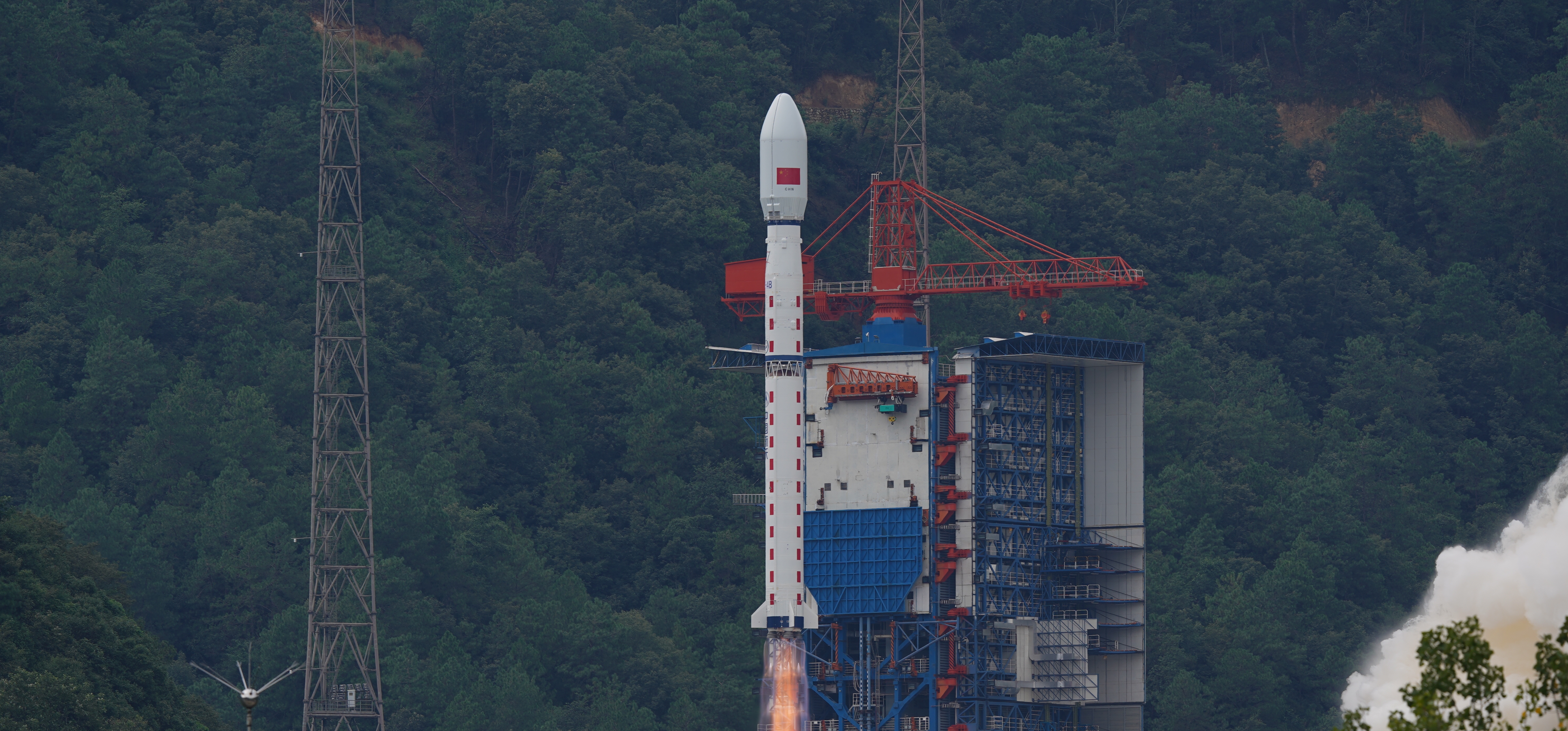
The ZY-3 (Ziyuan-3, 'Resource-3') series represents China's first high-resolution, stereoscopic mapping satellites for civilian use. The second satellite is managed by the Satellite Surveying and Mapping Application Center (SASMAC). The imaging payload consists of a three-line camera array and a multispectral imager. The three-line panchromatic camera array to acquire stereoscopic imagery consists of three telescopic cameras with one oriented to the nadir and the other two each offset by 22° forward and backward in flight direction. The stereo mapping camera of ZY-3 has a resolution of 2.1 m for the nadir camera, and 2.6 m for the offset cameras. The swath width is 51 km. The multispectral imager for environmental and vegetation monitoring consists of a three-mirror telescope and a cooled detector system sensitive to four wavelength bands to capture full-color imagery as well as near-infrared data. The ground resolution of this system is 5.8 m.
Zur Nutzlast-Seite →🎬 Aktuelle Videos
Keine aktuellen Videos gefunden — diese Zeile bleibt leer, bis es Neues gibt.
🚀 Über die Rakete: Long March 4B




📰 News
Der erfolgreiche Start markiert einen Meilenstein in der Raumfahrt Europas, auch wenn es bis zum zweiten Start der Spectrum wesentlich länger dauerte, als es ursprünglich anvisiert war. Mit diesem Start konnte nicht nur das Ziel höher und weiter bewältigt werden, als erstes der neu angetretenen privaten Raumfahrtunternehmen Europas hat Isar Aerospace mit ihrer eigenen Trägerrakete […] Der Beitrag
Isar Aerospace hat den 2. Testflug der „Spectrum“-Rakete für heute Abend angekündigt. Um (frühestens) 22:00 Uhr MESZ soll die Rakete vom norwegischen Weltraumbahnhof „Andøya“ abheben, vorbehaltlich dem Wetter, der Sicherheit und der Reichweite. An Bord sind 6 Nutzlasten: 5 CubeSats und 1 Experiment für das „Boost!“-Programm der ESA, das nicht von der Oberstufe getrennt wird. […] Der Beitrag 5. 9.
Am 1. September Abend feierten die Europäische Weltraumorganisation (ESA) und ispace-Europe im Rahmen einer Unterzeichnungszeremonie bei der Veranstaltung „Space for Inspiration“ in Kopenhagen, Dänemark, den Startschuss für MAGPIE, den ersten europäischen Rover auf dem Mond.Eine Pressemitteilung der Europäischen Weltraumagentur ESA. Quelle: ESA / Science & Exploration / Human and Robotic Explorati
Der 2. Testflug der Spectrum von Isar Aerospace ist nach Angabe von NextSpaceFlight ab 6. August möglich. Damit könnte man auf einen ähnlichen Starttermin wie RFA mit dem Erstflug der RFA One kommen, welcher nach Startplatzfreigabe von SaxaVord ab 10. August möglich ist. Der Beitrag 12. 7. 2026 – 2. Testflug der Spectrum im August möglich erschien zuerst auf Raumfahrer.net .
Isar Aerospace hat eine Vereinbarung mit Maritime Launch Services, welche einen Startplatz in der Nähe von Canso in Nova Scotia, Kanada errichtet, geschlossen um den Startplatz zukünftig für ihre Spectrum Rakete zu nützen. Im Rahmen eines 10-Jahres-Vertrags wird Isar Aerospace vierteljährlich 3,75 Millionen US-Dollar zahlen, wobei nach dem ersten Vertragsjahr eine 30-monatige Gebührenbefreiung gil
NASA gab die Auswahl von Astrobotic (2 Missionen), Firefly Aerospace und Intuitive Machines (je 1 Mission) bekannt, die im Rahmen des Mondbasis-Programms Ende 2028 vier neue Missionen auf dem Mond landen sollen. Desweiteren wird geprüft den Rover PROMISE, der als Engineering Testbed für Perseverance entwickelt wurde, auf den Mond zu schicken. Der Beitrag 1. 7. 2026 – NASA wählt Missionen für den M